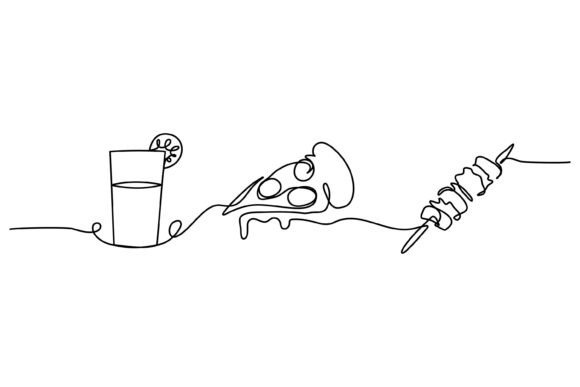
Continuous Line Design of Food: Elevating Visual Storytelling with Satay and Pizza Illustrations
In the crowded digital landscape, where attention spans are shorter than ever, visual simplicity has become a powerful tool for communication. This is where Continuous Line Design of Food steps in as a game-changer for creators and business owners alike. Unlike traditional detailed illustrations that can sometimes feel cluttered or heavy, continuous line art relies on a single, unbroken stroke to define form and shape. It is minimalist, elegant, and incredibly versatile. When applied to universally loved subjects like satay skewers and pizza slices, this artistic style transforms everyday food items into sophisticated decorative elements that resonate with modern aesthetics.
The appeal of a single line drawn on a white background lies in its clarity. There is no noise, no excessive shading, and no complex color palettes to distract the viewer. Instead, the eye follows the fluid motion of the line, creating a sense of movement and organic flow. For anyone looking to refresh their brand identity, enhance social media content, or add a touch of class to printed materials, understanding how to leverage these assets is crucial. Whether you are downloading an EPS file for large-scale printing or using a JPG for a quick Instagram post, the utility of these designs extends far beyond mere decoration.
Why Minimalist Food Art Works in Modern Branding
Many small business owners and marketers mistakenly believe that effective advertising requires loud colors and busy graphics. However, the trend toward minimalism suggests the opposite. A continuous line design of food and drinks offers a breath of fresh air. It signals sophistication and confidence. When a customer sees a clean, single-line illustration of a pizza slice on a menu or a website, they perceive the brand as contemporary and curated.
This style is particularly effective because it is ambiguous enough to be intriguing yet specific enough to be recognizable. The curve that defines the crust of a pizza also suggests the warmth of a freshly baked oven. The looping line that forms a satay skewer hints at the texture of grilled meat and the crunch of peanuts. These subtle cues engage the viewer’s imagination without overwhelming them. For entrepreneurs in the food industry, this means you can communicate your product offering without resorting to generic stock photography that everyone else is using.
Practical Use Cases for Creators and Entrepreneurs
Understanding the theory is one thing, but applying it to real-world scenarios is where the value truly lies. Here is how different users can integrate these single-line decorative elements into their workflows.
Social Media and Digital Content
For bloggers and social media managers, consistency is key. Using a continuous line design of food as a recurring visual motif helps establish a recognizable brand voice. Imagine a food blogger who uses a simple line-art pizza icon as a bullet point in their recipe lists or as a watermark on their photos. It adds a layer of professional polish without requiring hours of graphic design work. Since these assets often come in SVG format, they scale perfectly for both mobile screens and desktop headers, ensuring crisp visuals regardless of the device.
Packaging and Print Materials
Small business owners selling artisanal foods or hosting pop-up events can benefit immensely from these designs. Consider a local pizzeria launching a new loyalty card. Instead of a plain text list, they could use a series of continuous line pizza slices to track purchases. Similarly, a satay street food vendor could use the skewer illustration on their napkins, takeaway boxes, or even their staff uniforms. The fact that these designs are typically provided in EPS format means they can be sent directly to professional printers without losing quality, allowing for high-resolution output on various materials.
Web Design and User Interface
Web designers often struggle to find icons that are unique yet functional. Standard icon libraries can feel sterile and overused. Incorporating a hand-drawn feel through continuous line art adds warmth to digital interfaces. A restaurant website might use a single-line satay illustration as a divider between sections or as part of the loading animation. Because the background is white and the line is clean, it integrates seamlessly into both light and dark mode themes, offering flexibility that complex illustrations lack.
What You Get: Understanding File Formats
When you acquire these design assets, you are not just getting a picture; you are getting a toolkit. Most professional packages include three primary formats: EPS, SVG, and JPG. Each serves a distinct purpose in your creative workflow.
- EPS (Encapsulated PostScript): This is the gold standard for print. If you are designing a large banner, a menu board, or merchandise like t-shirts, you need EPS. It allows you to resize the image to any dimension without pixelation, ensuring that the single line remains sharp and smooth.
- SVG (Scalable Vector Graphics): Ideal for web and app development. SVGs are code-based, meaning they load quickly and can be manipulated with CSS. You can change the color of the line or add hover effects easily, making your website interactive and dynamic.
- JPG (Joint Photographic Experts Group): Perfect for quick, everyday use. If you need to drop an image into a Word document, an email newsletter, or a social media post immediately, the JPG is ready to go. It is universally compatible and requires no specialized software to view or insert.
Considerations Before You Choose
While the benefits are clear, there are practical considerations to keep in mind before integrating these designs into your projects. First, consider the context of your audience. Continuous line art is subtle. If your brand relies on high-energy, bold, and aggressive marketing, this minimalist approach might need to be paired with strong typography or vibrant accent colors to maintain impact. It works best when it complements rather than competes.
Secondly, think about versatility. A single line drawing of satay and pizza is specific, but its application is broad. Ask yourself if the style matches your existing visual identity. If your current branding uses heavy, realistic photography, introducing line art might require a gradual transition to avoid jarring your audience. However, for those starting from scratch or rebranding, this style offers a clean slate that is easy to build upon.
Finally, consider the emotional tone. Food is inherently sensory. While a photograph shows you exactly what the food looks like, a line drawing invites you to feel the experience. It is more abstract and artistic. Ensure that this aligns with the message you want to convey. Are you selling convenience, or are you selling an experience? Continuous line design leans toward the latter, suggesting care, craft, and attention to detail.
Enhancing Everyday Projects with Artistic Flair
Beyond commercial applications, these designs have a place in personal and educational settings. Educators teaching art or design can use these files to demonstrate the power of restraint and economy of line. Hobbyists creating scrapbooks or digital journals can use the pizza and satay illustrations to add a playful yet stylish touch to their layouts. The simplicity of the white background makes it easy to overlay text or combine with other elements without creating visual clutter.
For freelancers, having a library of such versatile assets can speed up client work. Instead of spending hours sketching custom icons, you can adapt these pre-made continuous line designs to fit specific project needs. This efficiency allows you to focus on strategy and content rather than getting bogged down in execution details.
In conclusion, the Continuous Line Design of Food is more than just a trend; it is a functional resource for anyone looking to communicate with clarity and style. By understanding the strengths of each file format and recognizing the diverse ways these illustrations can be applied, you can elevate your projects from ordinary to exceptional. Whether you are designing a menu, updating a website, or simply adding a creative touch to a personal project, these single-line decorative elements offer a perfect blend of simplicity and sophistication.